Master Battery highlights at IMDEA Energía the importance of tailoring research to the needs of industry
- Miguel Manjón, CTO of Master Battery, takes part in SOLENER-CM’s Research and Industry Forum, organised by IMDEA Energía, and emphasises the need to turn technological advances into reliable, competitive products tailored to the market.
- The Master Battery–UPM Chair promotes research into sodium-ion batteries as a technological alternative for certain energy storage applications.
Móstoles, 6 November 2026. Master Battery took part in the SOLENER-CM Research and Industry Forum, held at the IMDEA Energía premises. The event brought together representatives from research centres, universities and companies to analyse the main challenges of the energy transition and strengthen collaboration between the scientific and industrial sectors.
During the meeting, participants discussed advances in batteries and electrochemical storage systems, fuel cells, electrolysers and hydrogen-related technologies, with a particular focus on transferring research findings to the market and applying them to real-world energy solutions.
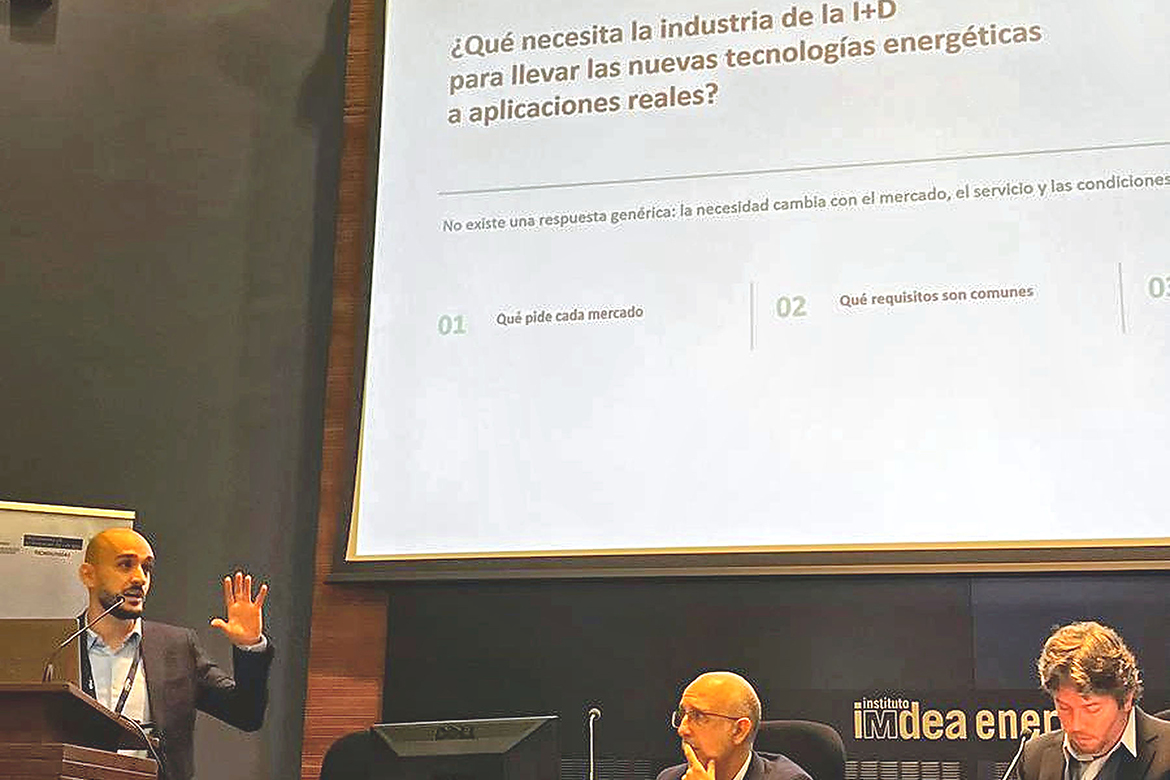
Miguel Manjón, Chief Technology Officer (CTO) at Master Battery, spoke to provide the industry’s perspective on a key issue: what companies in research and technological development need in order to transform scientific advances into products that can be manufactured, marketed and tailored to market needs.
Manjón pointed out that there is no single answer, as technological requirements vary depending on each sector and the applications for which the storage systems are intended. In the case of Master Battery, which develops solutions for sectors such as security, telecommunications, data centres and energy storage, requirements relating to autonomy, service life, safety, cost and monitoring are decisive factors in the design and development of the equipment.
“The main need for companies is that research should not be limited to achieving good results in the laboratory, but should enable the development of reliable products that can be manufactured and validated under real-world conditions,” explained Manjón.
In this regard, he emphasised that innovation in energy storage must take into account not only the development of batteries and new materials, but also the electronics, software and control systems that enable us to monitor their status, oversee their operation and optimise their performance.
Collaboration between research and industry: key to technology transfer
Another key point raised during the presentation was the need to strengthen collaboration between businesses, universities and research centres in order to bridge the gap between scientific advances and their industrial application.
As Manjón explained, the market sometimes evolves at a faster pace than research and validation processes; it is therefore essential to establish collaborative mechanisms that enable the identification of companies’ real needs, guide technological developments and facilitate their incorporation into commercial products.
As an example of this collaboration, he presented the work being carried out by the Master Battery–UPM Chair on sodium-ion battery research, an emerging technology with the potential to complement lead-acid and lithium batteries in certain applications, particularly in stationary storage systems.
Manjón summarised his approach by pointing out that “it is not a question of finding a battery that is the best at everything, but of developing the most suitable technology for each specific need and ensuring that it can become a safe, competitive and useful product for the market”.
A meeting to promote innovation and energy solutions
The SOLENER-CM conference brought together representatives from the research community and from companies and organisations such as Master Battery, Naturgy, AJUSA, H2 Dron Energy, H2Greem, Moeve and the Centre for Technological Development and Innovation (CDTI).
The event provided an opportunity to share progress across various lines of research, identify industrial needs and explore new opportunities for collaboration to facilitate the transfer of technology and knowledge to the business sector.
The event concluded with a visit to the IMDEA Energy Sandbox experimental facilities, an infrastructure designed for the integration, demonstration and validation of energy technologies under conditions representative of real-world applications.
By taking part in this event, Master Battery reaffirms its commitment to applied research, innovation and collaboration with universities and technology centres, with the aim of promoting energy storage solutions that meet the industry’s present and future needs.
About the SOLENER-CM project
SOLENER-CM (Development of solutions for the Community of Madrid’s energy system: improving the management of renewable generation through hybrid conversion and storage systems) is a research project forming part of the Community of Madrid’s 2024 R&D Programme for Collaboration between Research Groups in Technology, reference number TEC-2024/ECO-31.
The project aims to develop solutions that improve the integration and management of renewable energy within the Community of Madrid’s energy system. To this end, it is investigating hybrid conversion and storage technologies that will optimise the use of solar and wind power, improve their manageability and contribute to a more efficient, flexible and sustainable energy supply.